Walk into almost any marble showroom in India, point at a bright white slab with soft, cloudy veining, and ask the salesperson, “Where is this Michelangelo Marble from?” Nine times out of ten, you’ll get the same confident answer: “Italy, sir. Same as the sculptor.”
It sounds right. It feels right. Michelangelo was Italian, after all.
It’s also wrong. And the strange part isn’t that one salesperson got it wrong, it’s that this exact mistake has been repeated so many times, by so many people, for so many years, that it has quietly turned into something that feels like fact. That’s the real mystery here. Not where the stone comes from, but how an entire industry ended up believing, and repeating, a story that was never true to begin with.
The Mix-Up That Started Small
Here’s how a mix-up like this usually survives. Nobody sits down and deliberately invents a lie. Instead, someone makes a small, reasonable-sounding assumption, repeats it once, and the next person repeats it again, a little more confidently each time. After a few years, nobody remembers where the assumption started. It just becomes “common knowledge.”
That’s almost exactly what happened with Michelangelo Marble. The name sounds unmistakably Italian. Michelangelo, the Renaissance sculptor, is one of the most famous names connected to marble in human history. So when traders needed a name that instantly signaled premium quality, borrowing his name made perfect commercial sense, Italian or not.
What nobody clarified along the way was this: the name was always meant as a tribute to a standard of quality, never a claim about which country the stone was dug out of.
So Where Does the Real Stone Actually Come From?
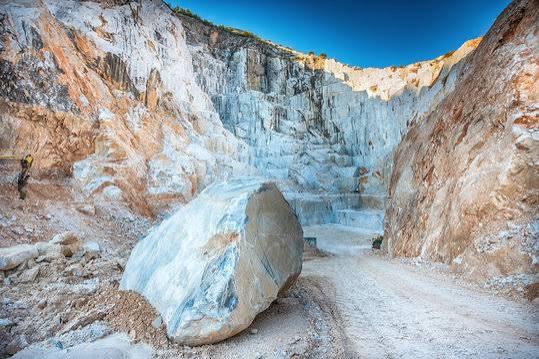
Michelangelo Marble is quarried in Portugal, specifically in the Estremoz region of the Alentejo area, around the towns of Estremoz, Borba, and Vila Viçosa. This is not some obscure, newly discovered quarry either. It sits on a geological formation called the Estremoz Anticline, which has been mined since Roman times, meaning this stone has a documented history stretching back roughly two thousand years.
Long before the name “Michelangelo” was ever attached to it, this Portuguese marble was already being used in Roman structures, medieval palaces, and monasteries across Portugal and Spain. By the 15th century, it was being shipped by Portuguese explorers as far as Africa, Brazil, and India, making it one of the most well-traveled marbles in history, centuries before it carried any Italian-sounding name at all.
Why the Name Stuck Anyway
Michelangelo, the sculptor, was known for being obsessively particular about the marble he chose. He personally traveled to quarries, inspected blocks with his own hands, and rejected anything that didn’t meet his standard, a bright, even, almost luminous white background with fine grain and delicate veining.
Over time, in the stone trade, his name stopped being just a person’s name. It became shorthand for a quality benchmark. So when Portuguese Estremoz marble began being marketed internationally, especially in markets like India, traders noticed it genuinely matched that same benchmark, a soft, elegant white tone with gentle veining capable of taking an exceptional polish. Calling it “Michelangelo Marble” wasn’t meant to deceive anyone about geography. It was meant to say, “this meets the standard he would have approved of.”
The mix-up happened later, when that intention got lost somewhere between one seller’s explanation and the next buyer’s assumption.
Why This Mystery Actually Matters to You
You might be thinking, does it really matter if people believe it’s from Italy instead of Portugal? Here’s why it genuinely does.
When a seller doesn’t know, or doesn’t bother to explain, the real story behind a stone’s name, it’s often a sign of something bigger, that they may not fully understand what they’re selling either. A supplier who can correctly explain that Michelangelo Marble comes from the Estremoz region of Portugal, not Italy, is far more likely to also understand its specific properties, how it behaves in humid climates, how it should be sealed, and which applications suit it best.
In other words, the name mix-up is a small test. How a seller handles it tells you a lot about whether they’re repeating a story, or whether they actually understand the stone.
What Makes the Real Story Even More Impressive
Once you strip away the Italian myth, the actual story of this marble doesn’t become less impressive, it becomes more interesting.
A Genuinely Ancient Material Quarried continuously for around two thousand years, with use in structures now recognized as UNESCO World Heritage sites.
Built for Tough Climates Highly crystalline with strong resistance to abrasion and notably low water absorption, a real advantage in a country like India with intense heat and heavy monsoons.
A Quieter, More Elegant Look Rather than bold, dramatic veining, it tends to show a softer, cloud-like pattern against a white to soft cream background, giving spaces a calmer, more understated elegance.
Portugal’s Answer to Italian Marble Within the trade, it’s often described as Portugal’s equivalent to Carrara, comparable in quality, simply without the same historical spotlight.
Where This Mystery-Solved Marble Works Best
- Living rooms and hallways, where its even, calming tone creates a cohesive, spacious feel
- Kitchen countertops and islands, where its low water absorption is a genuine practical benefit
- Bathroom walls and vanities, where durability matters in a consistently humid space
- Feature walls, for buyers who want elegance without overly dramatic veining
Why Source Genuine Michelangelo Marble in Kishangarh
Because this marble’s true story is so often misunderstood, where you source it from matters more than usual. Buying Michelangelo Marble in Kishangarh, India’s largest marble hub, means working with suppliers who handle Portuguese Estremoz marble regularly enough to know its real origin, properties, and best uses, rather than repeating an inherited myth they’ve never questioned.
Why Choose White Mansion Marble
As a trusted Best Marble Company in Kishangarh, White Mansion Marble believes buyers deserve the real story, not the convenient one. When you ask us about Michelangelo Marble, we won’t vaguely nod toward Italy. We’ll tell you honestly that it’s Portuguese, explain exactly why it carries that name anyway, and help you understand whether it’s genuinely the right fit for your space.
Frequently Asked Questions
Q1. Is Michelangelo Marble actually from Italy? No. This is the exact myth most buyers believe. Michelangelo Marble is quarried in the Estremoz region of Portugal, not Italy.
Q2. Then why does it have an Italian-sounding name? The name is a tribute to the sculptor Michelangelo’s famously strict standards for marble quality, not a claim about where the stone was actually quarried.
Q3. Is Portuguese Michelangelo Marble lower quality than Italian marble? No. Estremoz marble has its own two-thousand-year history of use in significant architecture and is often described in the trade as Portugal’s equivalent to Italian Carrara marble.
Q4. Why do so many sellers still say it’s from Italy? Most simply repeat what they were told without verifying it themselves, an assumption that has been passed along for years until it started sounding like established fact.
Q5. Why does it matter which supplier I buy Michelangelo Marble from? A supplier who understands and can correctly explain the stone’s real origin is far more likely to give you accurate guidance on its properties, sealing needs, and ideal uses as well.
Final Thought
The real mystery behind Michelangelo Marble in kishangarh was never about the stone itself; it was about how easily a small, reasonable-sounding assumption can travel from one person to the next until it quietly becomes accepted as truth. The marble was always genuinely excellent. It just deserved to be known for its real two-thousand-year Portuguese story, instead of a borrowed Italian one.
Want the real story behind every slab you buy? Visit White Mansion Marble, a trusted best marble company in Kishangarh, for genuine Michelangelo Marble in Kishangarh and honest answers, not inherited myths.